I just made my personal loopic replacement public on github.
AI Disclaimer: This was built largely with Claude Code. I’m programming for 40 years and work as a developer for 20 years, so this is the tool I used, don’t like it, don’t use it.
I provide TV graphics at international fencing events. Right now preparing for the world championships next week. So this fits my workflow but I think it’s general enough for anyone to use. If there are features missing it’s because I don’t need them, like freeform drawing of surfaces or masks, I simple don’t have a use case for that. But if people are using it and request a feature I’m open to add it.
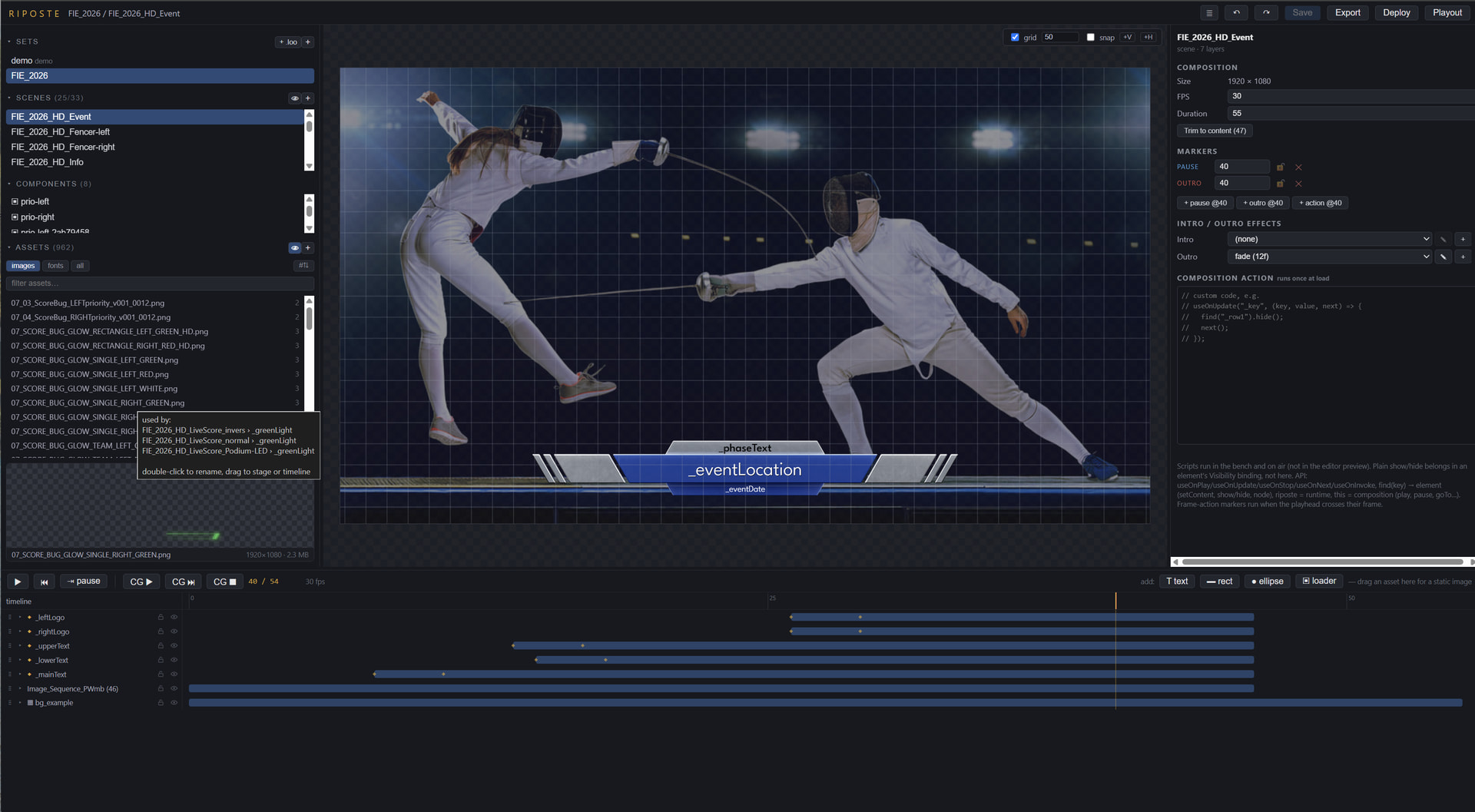
Riposte
A local, standalone studio for designing and exporting CasparCG HTML graphic templates. Riposte — the counter-attack that follows a parry.
Riposte is a browser-based motion-graphics editor plus a rendering engine, running entirely on your machine: a local Node server, an editor UI, and a small runtime that plays the graphics on air. Scenes are plain JSON, assets are plain files, and everything lives in a git-friendly project folder — no cloud, no accounts. Its core ideas:
- The runtime is the product. A small zero-dependency engine renders a
scene.jsonvia DOM+CSS and implements the CasparCG template contract (update/play/stop/next/invoke). The editor’s preview canvas runs that exact engine, so editor and on-air output cannot diverge. - A project is a set, not a scene. Many scenes share one
assets/folder — swapframe.pngonce and every scene in the set is rebranded. Assets are plain files, content-hash deduplicated; projects are diffable JSON. - Exports stay small. Template shells reference the shared assets folder (with an optional baked single-file fallback for compatibility).
Features
Editor
- Stage with direct manipulation: drag, multi-select (group move/delete), resize handles, on-stage mask handles, snap-to-grid (center-anchored), ruler guides (lockable, layers snap to them), layer locking, zoom/pan.
- Timeline: per-layer spans, keyframes with bezier easing, keyframe copy/paste across elements and scenes, layer reordering (drag or Ctrl+arrows), draggable markers with per-marker locks — pause, outro (
stop()plays from there), loop, and frame actions (JS). - Inspector for every element type: text (incl. tabular numerals / digit boxing for jitter-free clocks), image, image sequence, image loader (runtime-fed image with design-time placeholder), rectangle/ellipse (with dynamic size binding — a bar that follows a text layer’s measured width), nested composition.
- Components: reusable nested compositions — edit once, every scene that embeds one follows; drag a component from the sidebar onto the stage to embed it. Convert scene ⇄ component, extract a selection into a new component (or move it into an existing one); loop regions inside a nested component keep cycling while the parent scene holds.
- Scene-level intro/outro presets: named, reusable effects (fade, wipes, slides, an inverted-mask diamond…) played on ADD and STOP around the scene’s own animation — with a visual preset editor previewing live on the real scene, and a stock collection seeded into new sets.
- Masks per layer, animatable x/y/w/h, rotation, inverted, per-corner radius.
- Data bindings:
update()payload keys map to elements (_nameconvention, dot paths into nested components), visibility bindings with initial state, per-scene preview data for design-time. - Asset management: drag-and-drop import, image sequences auto-grouped (rename, drag to stage as one), hover preview pane (images, sequences, live font samples), usage tracking with one-click delete-unused, per-scene visibility filter for the scene list.
- Undo/redo, per-file dirty tracking (unsaved scenes marked everywhere, auto-saved before export/deploy), deep links (
?set=…&scene=…&frame=…&layer=…), resizable persisted panels.
Export & deploy
- Incremental export: tiny per-scene HTML shells + one shared
assets/folder and runtime; only changed files are written. - Optional PNG→WebP re-encoding on export (cached, lossy/lossless race per image; the set on disk stays PNG) — real-world set: 213 MB → 27 MB.
- One-click deploy into a CasparCG template directory — additive and incremental, with an optional force-full-redeploy.
- Mapping-contract check on export/deploy: warns about template keys no controller mapping fills and mappings pointing at removed keys.
- Baked single-file export as a compatibility fallback (all assets inlined).
Rehearsal without a broadcast rig
- Virtual CasparCG: the server speaks AMCP on its own ports, so the real production controller connects to Riposte as if it were a Caspar server; a playout page renders what would be on air (main + preview feeds). Doubles as a wire-tap to inspect exactly what a graphic receives.
- Bench: load any exported scene, inject
update()data, step the lifecycle (add/play/next/stop),?debug=<key>logs element geometry per update.
Automation
- MCP server: the full authoring surface (~50 tools) — set/scene CRUD and conversion, layers, keyframes, masks, markers, loops, bindings, effect presets, asset management, headless scene/filmstrip rendering, export/deploy, and live bench control. An AI assistant can build a graphic from a blank set to a deployed template, and verify it visually, end-to-end.
- Importer for Loopic
.looprojects (scenes, assets, scripts).
Distribution
npm run distbuilds a portable zip: bundled server, built editor, start scripts — recipients need only a Node.js LTS install.